

Looking at PMS returns in India through platforms like PMS AIF WORLD is not only about chasing numbers. It is also about seeing how conviction actually plays out when capital is concentrated.
Unlike mutual funds, where diversification does much of the work, PMS tends to rely more on active judgment, sometimes sharp, sometimes uncomfortable, and not always consistent.
That distinction becomes clearer once recent portfolio management performance is looked at more closely.
How Performance Has Been Over The Years?
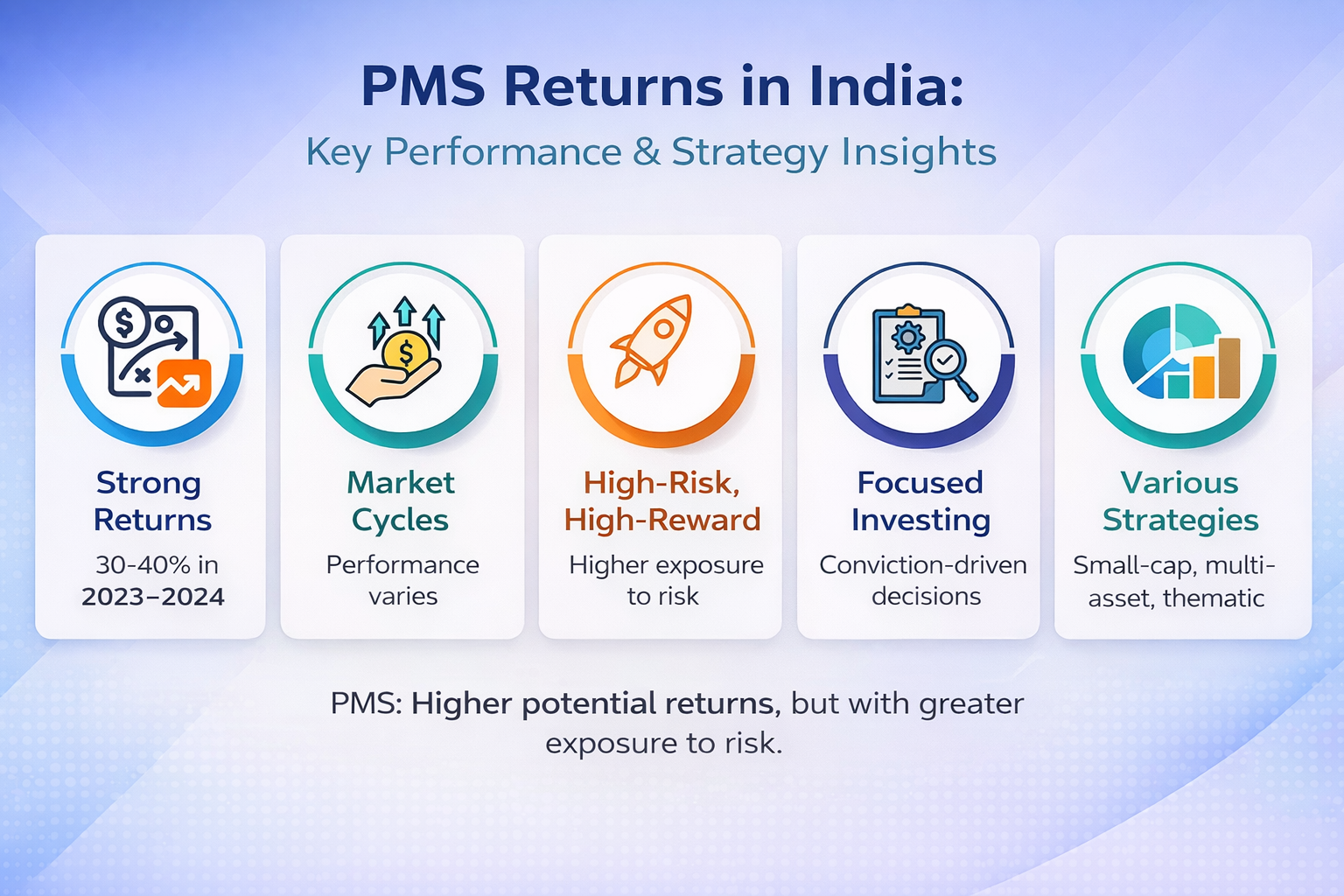
If the numbers from 2023 and parts of 2024 are taken at face value, average PMS returns in India can look almost decisively superior. Many strategies delivered returns in the 30 to 40 percent range, comfortably ahead of the Nifty 50.
Through 2025 and into early 2026, things started to spread out more. In strong phases, a fair number of PMS strategies, sometimes over half, continued to outperform. But during volatility, that same consistency was harder to find. There were months when outperformance narrowed sharply, leaving only a smaller group of portfolios ahead of the benchmark.
That shift is easy to overlook, but it changes how PMS performance analysis needs to be approached.
Looking only at headline numbers no longer says enough. On platforms like PMS AIF WORLD, where comparisons sit side by side, the variation across cycles begins to matter just as much as the returns themselves.
Some strategies still stood out.
Among the top PMS returns in India, small-cap-focused portfolios and multi-asset approaches posted strong one-year returns in 2025, with a few even crossing the 40 percent mark.
At the same time, drawdowns became harder to ignore. In concentrated small-cap portfolios, corrections could show up quickly, sometimes more quickly than expected.
Large and mid-cap oriented strategies behaved differently. They did not lead the rally in the same way, but they did not slip as sharply either. That balance, or trade-off, feels more visible now than it did a couple of years ago.
The Nature of Strategy
At its core, high-return PMS strategies rest on a fairly simple idea. Fewer stocks, but understood well enough to justify holding them in size.
Most portfolios sit somewhere between 15 and 30 holdings. The aim is not to spread risk thin across too many names, but to lean into a smaller set of opportunities where conviction is stronger.
It does not play out the same way across strategies, though.
Multi-cap approaches tend to move across market segments without being tied to rigid allocation rules. They shift when needed, sometimes gradually, sometimes not, depending on where valuations begin to look more reasonable.
Volatility is still part of the picture, but these portfolios rarely move to extremes.
Small and mid-cap strategies follow a different path. They are built around discovery, often looking for businesses before they become widely tracked.
When it works, portfolio investment returns can be outsized. When it does not, drawdowns tend to show up just as clearly. There is not much of a middle zone here.
Thematic portfolios take a narrower view. Instead of spreading exposure, they stay with a single idea, healthcare, digital businesses, or manufacturing, depending on where the cycle seems to be moving.
Outcomes then depend less on individual stock picks and more on whether the broader theme holds up.
Then there are multi-asset strategies.
They have been getting more attention lately, not because they lead on returns, but because they make the overall ride less uneven.
By combining equity with debt, sometimes even gold, they give up a bit of upside in exchange for stability.
Platforms like PMS AIF WORLD, which emphasize comparison and evaluation, rely on standardization to make performance more interpretable across strategies. It does not eliminate risk, but it reduces the room for ambiguity.
How Capital Is Being Deployed Right Now?
As of early 2026, the market does not offer a clear directional cue. There is movement, but also hesitation. In such an environment, many PMS managers have shifted towards staggered deployment.
Instead of committing capital in one go, allocations are spread out over time. Dips are used to build positions gradually, often with an equal-weight approach rather than heavy front-loading.
Sector preferences are also telling. There is a visible tilt towards areas with structural demand, auto ancillaries, and healthcare, segments where growth is not entirely dependent on short-term sentiment.
It is not aggressive positioning. If anything, it feels measured.
Wrapping Up
PMS returns in India, when approached through comparison-led platforms like PMS AIF WORLD, sit somewhere between discipline and discretion.
They can outperform meaningfully, but they do so with sometimes less predictability than broad-based funds.
That is perhaps the more honest way to look at portfolio management performance. Not as a superior alternative, but as a more exposed one.

