

Dear Investors,
Indian markets extended their rally for a third consecutive month in May, supported by strong domestic growth, easing inflation, and steady foreign portfolio inflows. India’s GDP rose 7.4% in Q1 2025, driven by construction and manufacturing, lifting full-year FY25 growth to 6.5%. Inflation softened notably, with April CPI at 3.16% – the lowest since 2019 – and WPI at 0.85%, both comfortably within the RBI’s target range.
Nifty 50 gained 1.7%, Sensex rose 1.5%, and FPIs pumped in $2.6 billion – the highest inflow since late 2024 with financials, autos, and real estate leading sectoral gains. May also marked a broader shift in global sentiment as central banks embraced a rate-cut cycle and the U.S. Dow hit record highs, fueling a risk-on trade that benefited emerging markets like India. The government and RBI have ramped up spending, accelerating infrastructure momentum. Interestingly, the market is now valuing businesses with a long-term lens, assigning premiums not for 5–7 years but for decades of compounding potential, a shift often missed by conventional analysis. Morgan Stanley even suggests India could be pivotal in preventing a global recession, especially as China battles deflation and slowing growth. India is expected to contribute 20– 25% to global growth, and as the earnings upcycle gains strength, foreign investors may soon realize they’ve under allocated to this opportunity. With market-wide stock correlations peaking, the stage is set for a stock-picker’s market, where fundamentals, not just macros, will drive returns. In this phase, conviction and patience are likely to be richly rewarded.
On June 6, 2025, the Reserve Bank of India (RBI) surprised markets by cutting its repo rate by 50 basis points to 5.50% and slashing the Cash Reserve Ratio (CRR) by 100 bp, which will infuse approximately ₹2.5 lakh crore (₹2.5 trillion) of durable liquidity into the banking system by around November–December 2025. This torrent of liquidity is designed to lower banks’ funding costs, encourage more aggressive lending, and support economic growth amid subdued inflation. The ensuing stimulation is expected to boost capital markets, equity markets are likely to benefit from increased corporate borrowing, higher profitability, and improved market sentiment – creating a favorable environment for accelerated wealth generation among investors.
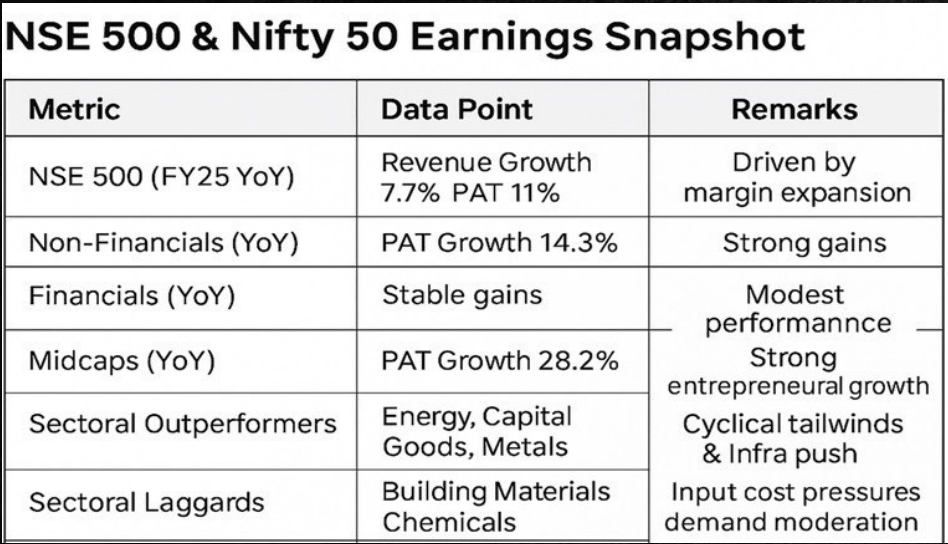
Corporate India : Present quarter witnessed Q4 Y 25 earnings updates & India Inc. posted strong FY25 earnings with 7.7% revenue and 11% PAT growth, led by midcaps and nonfinancials. Sectors like energy, capital goods, and metals outperformed, while building materials and chemicals lagged.
Here we present detailed snapshot along with how last 5 years in this decade saw massive rise in corporate earnings vs the previous decade. Post-COVID, structural earnings growth has sharply accelerated, transitioning from hyper-growth to sustainable profitability with robust capital efficiency. Lets take a look!
Indian corporate earnings has seen a structural shift in last 5 years vs the previous decade. The period from FY2020 to FY2025 marks a stark contrast to the previous decade, with a powerful resurgence in corporate earnings driving market performance. NSE 50 earnings CAGR surged to 20% in FY20–25 from a 7% in FY10–20, while its index CAGR rose to 22% from 5%.
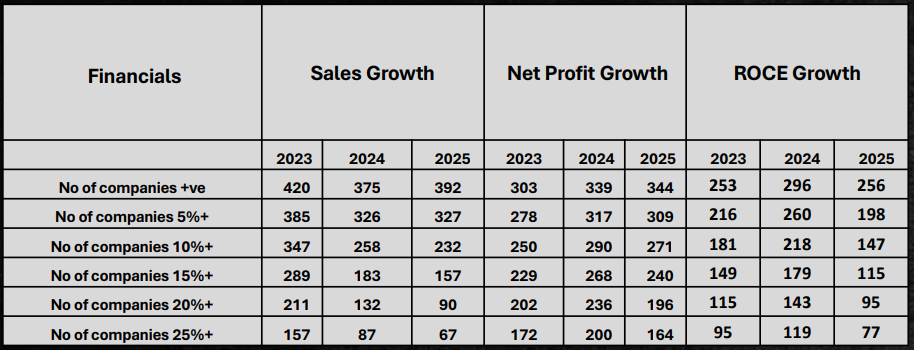 India Inc.’s earnings trajectory over FY21–25 reveals a compelling story of recovery, peak momentum, and subsequent normalisation. The Nifty 500 earnings growth analysis shows that FY22 and FY23 were standout years, with record numbers of companies delivering robust topline and bottom-line growth. In FY22, 432 companies reported positive sales growth, with 364 crossing 10%, and 323 exceeding 15% — a post-COVID rebound that fuelled investor optimism.
However, FY24 and FY25 mark a return to equilibrium. While 375 companies still reported positive sales growth in FY24, only 183 clocked growth above 15%. FY25 shows similar moderation, indicating that the phase of aggressive expansion is giving way to steady-state performance. On the profitability front, 317 companies still achieved over 5% profit growth in FY24, with 268 exceeding 15%, reaffirming strong earnings resilience.
ROCE trends and cash flow from operations mirror this pattern — peaking in FY24 and marginally dipping in FY25 — yet remain at healthy levels. The number of companies with rising ROCE touched 296 in FY24, while 276 companies posted positive operating cash flow growth.
Overall, the data reflects a maturing earnings cycle — not a slowdown, but a shift from hyper-growth to sustainable profitability with robust capital efficiency.
India’s economic and corporate resilience continues to position it as a standout story in an uncertain world. As the earnings cycle matures, the emphasis is shifting from broad-based recovery to focused, high-quality growth. This presents a fertile ground for active investing — where conviction, selectivity, and strategic asset allocation will drive long-term returns.
For a detailed analysis and insights on around 200+ PMS and AIF Strategies, login to our analytics portal. Login to Learn – Compare – Select from the universe of professionally managed focussed investment portfolios.
Login to Our Analytics Portal
Database of all stocks / sectors & returns / risk matrices & insights of PMS & AIF
Our endeavors are to determine the Quality, Risk, and Consistency attributes (QRC). We present all data and analytics with an endeavor and the aim of informed investment decisions. If you are looking to invest and are not able to decide between PMS and Mutual Funds, or between PMS and Alternative investment funds, Book A Video Call with our experts.
Wish to make INFORMED INVESTMENTS for Long Term WEALTH CREATION
Do Not Simply Invest, Make Informed Decisions
 Book a call with our Experts

