

Markets have a habit of creating the loudest optimism near peaks and the deepest pessimism near opportunity. The current global environment feels like a perfect reflection of this reality. On one side, the United States continues to witness extraordinary optimism driven by artificial intelligence, mega-cap technology stocks, and abundant global liquidity. The Nasdaq has rallied sharply, headlines are celebrating trillion-dollar companies almost every week, and investor enthusiasm appears relentless.
Meanwhile, the mood in India feels far more cautious. Over the past few weeks, Indian markets have witnessed volatility amid rising crude oil prices, geopolitical tensions, pressure on the rupee, and concerns around foreign institutional flows. Brent crude threatening the US$100 mark once again, combined with global growth concerns, has naturally created nervousness across emerging markets. In such an environment, daily market movements can easily make investors feel that global capital is rewarding only developed markets while India is temporarily being left behind.
But if we step away from the noise of short-term market movements and observe the broader picture carefully, a very different story begins to emerge.
Despite all the excitement surrounding global markets, many of them today trade at valuations that already discount years of near-perfect growth. According to the latest global valuation data from the World PE Ratio Database, the United States trades at a PE of 26.25 and Taiwan at 24.9 — both categorised as expensive relative to historical averages. South Korea, despite its sharp rally and massive AI-led momentum, trades at 21.14 PE and is also classified as expensive. Japan, Canada, Hong Kong, Singapore, and several European markets similarly continue to trade in expensive or overvalued territory after their strong rallies.
India, interestingly, no longer appears overheated.
India currently trades at approximately 20.8 PE and is categorised as “Undervalued/Fair” relative to its historical averages despite being one of the world’s fastest-growing large economies. This shift is important because for the first time in many quarters, Indian equities are no longer being driven purely by optimism or liquidity, but are increasingly reconnecting with underlying fundamentals.
The resilience is visible not only in economic indicators but also in market behaviour across regions:
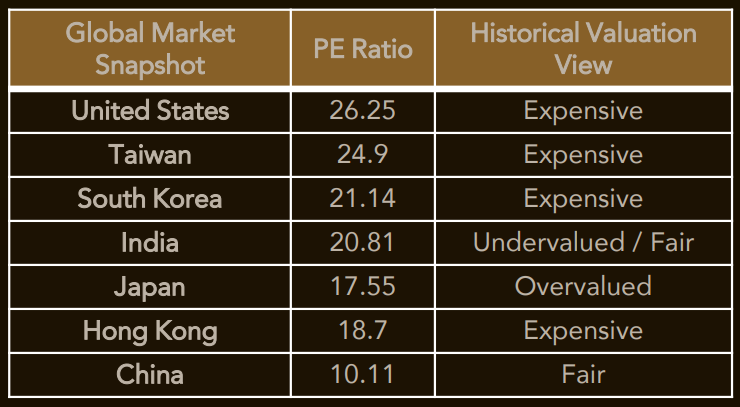
This divergence itself tells an important story.
Many global markets today are benefiting from concentrated themes such as AI semiconductors, technology rerating, or liquidity-driven momentum. Taiwan and Korea, for instance, have seen enormous rerating largely due to the semiconductor and AI supply-chain boom. While these themes may continue for some time, history suggests that markets driven by narrow enthusiasm often become vulnerable once expectations become excessively optimistic.
India’s growth story, in contrast, remains far broader and fundamentally domestic in nature.
Consumption growth, infrastructure creation, manufacturing formalisation, digitisation, premiumisation, financialization of savings, and rising entrepreneurial activity are all contributing simultaneously to India’s long-term economic transformation. Sustainable wealth creation rarely emerges from temporary excitement. It emerges from economies capable of compounding steadily through multiple engines of growth over long periods of time.
Even amidst the current volatility, India’s underlying macro signals continue to remain remarkably resilient.
India recently recorded its highest-ever GST collections at approximately ₹2.43 lakh crore, reflecting ongoing formalisation and economic activity. Retail inflation remains relatively contained near 3.5%, foreign exchange reserves continue to remain robust near US$690 billion despite currency intervention, infrastructure spending remains elevated, and domestic investor participation has become structurally deeper than ever before.
April itself demonstrated this resilience very clearly. After forming an important bottom on 31st March 2026, Indian equities staged a strong and broad-based recovery led by midcaps, smallcaps, infrastructure, metals, automobiles, FMCG, and PSU-linked themes. The recovery clearly indicated that domestic liquidity and longterm investor confidence remain intact espite global uncertainty.
This does not mean risks should be ignored. Elevated crude oil prices, geopolitical conflicts, currency volatility, and slowing global growth can continue to create intermittent corrections and emotionally difficult phases for investors. Volatility may remain elevated over the coming months.
But volatility and structural weakness are not always the same thing.
At PMS AIF WORLD, our endeavour has always been to separate temporary fear from long-term opportunity. Our focus remains on disciplined asset allocation, prudent manager selection, valuation awareness, and helping investors maintain perspective during uncertain times.
Because in investing, the strongest opportunities often emerge precisely when confidence becomes hardest to hold.
For a detailed analysis and insights on around 200+ PMS and AIF Strategies, login to our analytics portal. Login to Learn – Compare – Select from the universe of professionally managed focussed investment portfolios.
Login to Our Analytics Portal
Database of all stocks / sectors & returns / risk matrices & insights of PMS & AIF
Our endeavors are to determine the Quality, Risk, and Consistency attributes (QRC). We present all data and analytics with an endeavor and the aim of informed investment decisions. If you are looking to invest and are not able to decide between PMS and Mutual Funds, or between PMS and Alternative investment funds, Book A Video Call with our experts.
Wish to make INFORMED INVESTMENTS for Long Term WEALTH CREATION
Do Not Simply Invest, Make Informed Decisions
 Book a call with our Experts

