

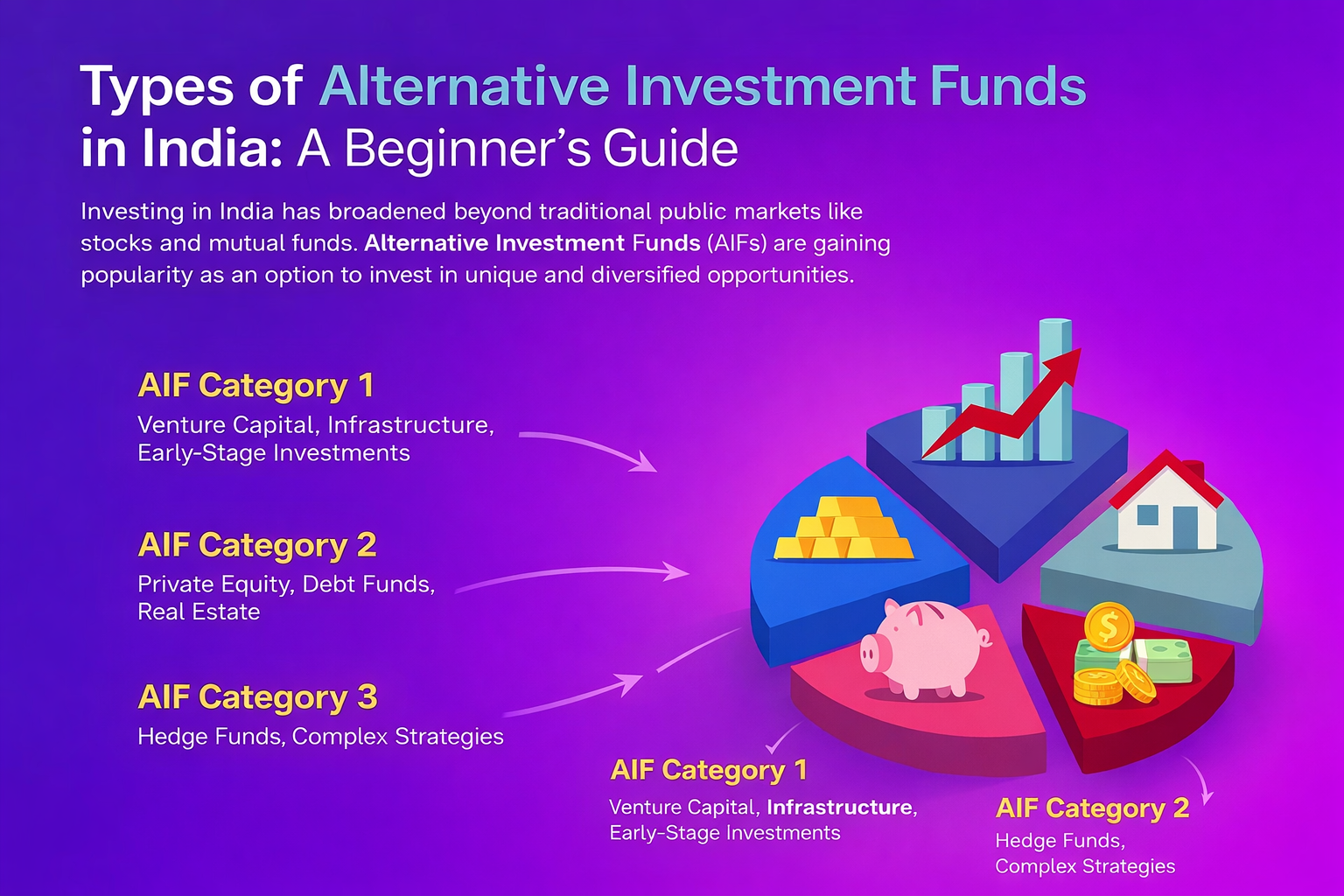
The conversation around investing in India has shifted over the last few years.
It’s no longer just about equities or mutual funds. At some point, the question turns toward types of alternative investment funds, especially for those looking to move beyond public markets.
AIFs sit in an interesting space. They’re structured, regulated, but not as standardised as traditional products.
The framework itself comes from the SEBI AIF classification, under the supervision of the Securities and Exchange Board of India, but within that framework, there’s a fair amount of flexibility in how capital is actually deployed.
That flexibility is really the point.
How the Alternative Investment Fund Structure Works
The alternative investment fund structure is quite different from what most investors are used to.
For one, liquidity is not immediate. Capital is committed, not parked. Once invested, it tends to stay locked in for a few years.
The ₹1 crore entry point reinforces that this space is meant for investors who can afford both the risk and the waiting.
Because of this, fund managers are not chasing short-term movements. They can afford to think in longer arcs or, in some cases, in more specialised ways.
That’s where the categories begin to matter.
AIF Category 1 Funds: Where Capital is Directed
With AIF Category 1 funds, the intention is quite visible. These funds tend to move toward areas that are considered important from a broader economic standpoint.
Venture capital is the obvious example. Money goes into early-stage companies, often before the business model is fully proven. There’s uncertainty built in, but also the possibility of outsized outcomes.
Infrastructure feels almost like the opposite. Long timelines, heavy capital, slower returns, but once things stabilise, the cash flows can be steady.
Angel funds take an even earlier view than venture capital, backing founders at a stage where conviction matters more than data.
Then there are social venture funds, where returns are not the only metric being watched. Impact becomes part of the conversation.
So Category I isn’t really about speed or liquidity. It’s about direction.
AIF Category 2 Funds: Where Most Activity Happens
If Category I feels intentional, AIF Category 2 funds feel practical.
This is where a lot of the actual investing happens. No leverage for investment, relatively defined deal structures, and a clearer sense of how returns might play out.
Private equity is a part, investing in unlisted businesses and building value over time. Sometimes that means operational changes, sometimes just capital support at the right moment.
Debt funds operate differently. They lend rather than own, stepping in where traditional financing may not be easily available. Returns are usually more predictable, though not risk-free.
There are also funds of funds, which spread exposure across multiple AIFs, and real estate funds, which tie returns to property cycles rather than stock prices.
Category II doesn’t try to do too many things at once. It focuses on execution.
AIF Category 3 Funds: Where Strategy Takes Over
Then you get to AIF Category 3 funds, and the tone shifts a bit.
These funds are less about holding assets and more about using AIF investment strategies to navigate markets actively. Leverage is allowed, derivatives come into play, and the time horizon is usually shorter.
Hedge funds are the most recognisable here. They might go long in some places, short in others, or look for arbitrage opportunities. The idea is not to depend entirely on market direction.
PIPE deals are slightly different. They involve taking positions in listed companies, often through negotiated entries, blending private capital with public exposure.
There’s more movement in Category III. But also, more unpredictability.
Where This Fits in Practice
AIFs are often positioned as alternatives, but that framing can be slightly misleading. They’re not replacing anything.
They’re adding another layer.
For someone exploring opportunities through PMS AIF WORLD, the appeal usually lies in the access it offers. Access to private businesses, to structured credit, to strategies that don’t exist in plain sight.
But access comes with a requirement. Understanding what’s underneath.
Wrapping Up
The types of alternative investment funds are easy enough to list. Category I, II, III. The SEBI AIF classification makes sure of that.
What’s harder, and more important, is understanding how each category behaves once capital is deployed.
Because in the end, AIFs are not just about where money goes.
They’re about how patiently and intelligently it stays there.

