

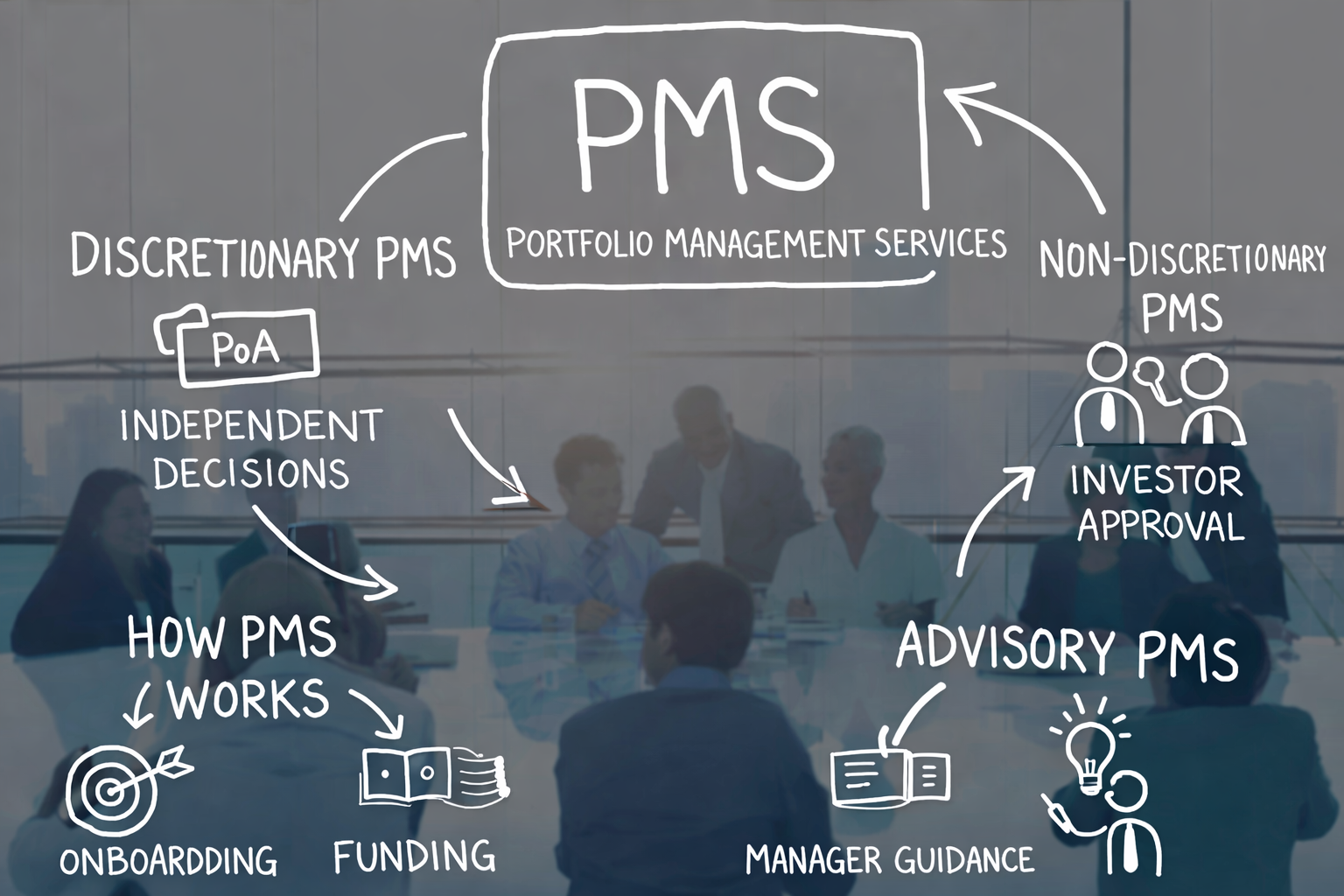
As of 2026, Portfolio Management Services (PMS) continues to occupy a distinct, somewhat specialised position within India’s investment landscape.Search queries such as PMS full form in finance or PMS meaning in stock market usually converge to a single structural shift.
It is not designed for the broad base of retail participants. Instead, it tends to attract High Net Worth Individuals who prefer a more deliberate and visible approach to portfolio construction.
It is about moving away from pooled capital and toward individually aligned portfolios. That shift, while conceptually simple, changes the investment experience in a fundamental way.
What is PMS?
PMS, or Portfolio Management Services, refers to a professional arrangement in which a portfolio manager allocates and manages investments across equities, fixed income instruments, and other securities for an individual investor.
This also reflects the broader portfolio management services meaning, where management is tailored at an individual level rather than pooled.
Thus, for those exploring what is PMS investment, it often helps to move away from the idea of a product.
In India, PMS operates under SEBI regulations, with a minimum investment requirement of ₹50 Lakhs. This threshold is not merely regulatory. It effectively shapes the PMS definition finance India, placing it within a segment where concentration is expected, and short-term volatility is tolerated, sometimes even anticipated.
Over the past few years, access has also become more structured.
Platforms such as PMS AIF WORLD now allow investors to compare strategies, evaluate managers, and observe performance dispersion without relying entirely on fragmented sources.
Legal Structure
At its foundation, PMS follows a principal-agent framework.
The investor continues to remain the legal owner of all underlying assets, while the portfolio manager operates within a defined mandate to execute transactions.
Each PMS account is tied to its own demat and bank account, rather than being part of a pooled arrangement. Holdings are not combined across investors. Instead, securities are attributed directly to the investor through depositories such as NSDL or CDSL.
It may appear to be a technical distinction at first glance, though in practice, it has clear implications, particularly when compared with traditional pooled investment vehicles.
Types of PMS
The operational side of PMS is shaped largely by how decision-making authority is allocated between the investor and the manager.
Discretionary PMS
Under this structure, the manager makes investment decisions independently, usually backed by a Power of Attorney (PoA). It remains the most prevalent format in India and, for many investors, the default approach.
Non-Discretionary PMS
Here, the manager offers recommendations, but execution is carried out only after investor approval. As a result, the investor remains more actively involved in the process.
Advisory PMS
In this case, the manager’s role is limited to providing guidance, while all execution decisions rest entirely with the investor.
For those exploring PMS explained for beginners, this distinction often becomes more relevant than the strategy itself, at least initially. It directly influences the level of involvement an investor has in day-to-day portfolio decisions.
How PMS Works?
Even though strategies vary across managers, the PMS process itself tends to follow a broadly similar flow:
Onboarding
Risk profiling is conducted to define objectives, constraints, and overall investment orientation.
Funding
Capital allocation begins at ₹50 Lakhs. This may come through fresh funds or via the transfer of existing securities.
Account Setup
A dedicated demat and bank account are created.
Power of Attorney (PoA)
The manager is authorised to execute transactions.
Active Management
The portfolio is reviewed continuously, with adjustments made as market conditions or valuations evolve.
Reporting & Transparency
Investors receive periodic updates and retain direct visibility into holdings. Many also rely on aggregation platforms such as PMS AIF WORLD to track multiple PMS strategies side by side.
Audit & Taxation
Annual reports include audited statements along with capital gains summaries. The level of detail here is typically higher than what most pooled vehicles provide.
Wrapping Up
Portfolio Management Services brings together ownership, transparency, and customization within a professionally managed framework.
In that sense, PMS is not simply an alternative to mutual funds. It is a different way of participating in markets, one that leans more toward active, manager-driven decision-making.

